
Nouvelle Vague – United States/France – 2025 – Drama
Directed by: Richard Linklater
Written by: Holly Gent; Vincent Palmo Jr.
Main Players: Guillaume Marbeck; Zoey Deutch; Aubry Dullin; Jodie Ruth-Forest; Adrien Rouyard; Antoine Besson; Bruno Dreyfürst
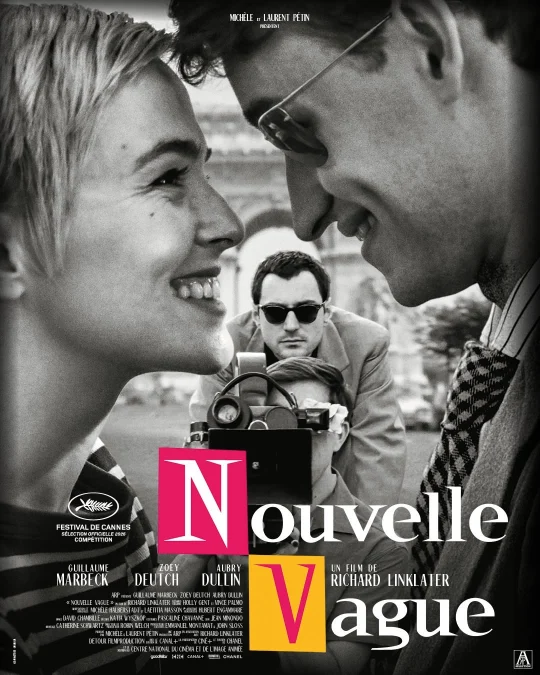
An interesting exploration into filmmaking and the psyche of director Jean-Luc Godard (Marbeck), Nouvelle Vague reflects a love of movies, and the creative process. Join the experience as it explores the filming of Breathless.
It is 1959, and a young Godard is a film critic, along with other youthful industry hopefuls François Truffaut (Rouyard), Claude Chabrol (Besson), and Suzanne Schiffman (Ruth-Forest). All of these names are now famous in French cinema, as writers, directors, or both.
They watch and review ‘La Passe du diable,’ deciding that they now know all civilization is mortal, even film. At least there are free drinks at the after party, and more cinema industry players, such as the film’s director Georges de Beauregard (Dreyfürst). Godard speaks with the man, shitting on his film, however Beauregard tells him he is his favorite critic. Godard is ready to direct a film, and now. He’s upset he is already 25 and yet no full-length films are under his belt.
Truffaut is readying his own first film The 400 Blows for the Cannes Film Festival, so Godard bitches to Suzanne Schiffman about desperately needing to get behind the lens and direct. He’s the only one of his peers to be left out of this arena. She tells him put up or shut up. So here we go, Godard is motivated to craft his own story and finally direct it. What will happen next?
Nouvelle Vague is a fun dive into the filmmaking process, and the mindsets of young actors, writers and directors. Taking place in 1959 and France, there are some cultural differences from America, however the motivations, feelings and challenges are all applicable to most anyone, anywhere. Director Richard Linklater clearly loves the film ‘Breathless’ which his own film dives into meticulously, but in doing so he has also created quite an interesting companion piece, with both enhancing each other.
The exploration presented within reflects an interesting time in the history of film making, and some influential directors and decisions. While Breathless is not an all-time favorite of mine, it is a quality time and I recognize its impact on history and do like its film making style, even if the story and characters are a bit of a hold back for me.
Looking to present a “new wave” of films, Godard sets out to craft something stand-out for the cinemas. Watching the process of Breathless through Linklater’s script brings the viewer into the artistic process and fills it with an informative and interesting time. Linklater himself presents this film in black and white to match the aesthetic of Breathless, and in doing so puts a timeless feeling into Nouvelle Vague.
The full-frame shots are nicely planned and well-focused, delivering a classic visual experience, similar to the film Breathless itself. The main actors sink into their roles quite successfully, and there is a lot to enjoy about this film in general. I actually like this a touch more than Breathless itself, due to the subject matter, characters and script being a bit more appealing to my personal taste. The deep look into film making and creative processes, reasoning, thought and feeling behind it all, was a lot of fun for me.
Breathless itself is not bad at all, but it doesn’t rock my world as an all-time influential classic, unlike Richard Linklater who clearly adores it, along with many others. Despite this, Nouvelle Vague’s presentation reflecting how it all came together was quite enjoyable. My main caveat about this film, is that it is all talking so you must be able to handle that kind of a pace.
“Think of Rosellini. Be fast like him. Be witty like Sacha Guitry, musical like Orson Welles, simple like Marcel Pagnol. Be wounded like Nicolas Ray, effective like Hitchcock, and insolent like no one else.”
See This If You Liked:
Breathless (1960; 1983); Blue Moon (2025); Irma Vep; Midnight in Paris; The Artist (2011); The Disaster Artist; The 400 Blows (Les quatre cents coups); Before Sunrise; Mank
Score:
7.5